
the Game
Pick the matchup. Send the double. Pay the price.
Your Game Plan can now choose who guards their best players and when to double-team them. Every call shows its price before you save, and the box score shows what it cost and what it won.
A GM sent me a short message this week: let me set up defensive matchups, or double-team a specific player. It's a fair ask. The engine has always decided who guards whom, and it has always sent help when a scorer heats up. You just couldn't see it, and you couldn't change it. Now you can do both.
Where it lives
Open your Game Plan and switch to Next opponent. There's a new card called Matchups. It lists their top threats, with position, height, points and usage from their public stats. Under each one are two controls.
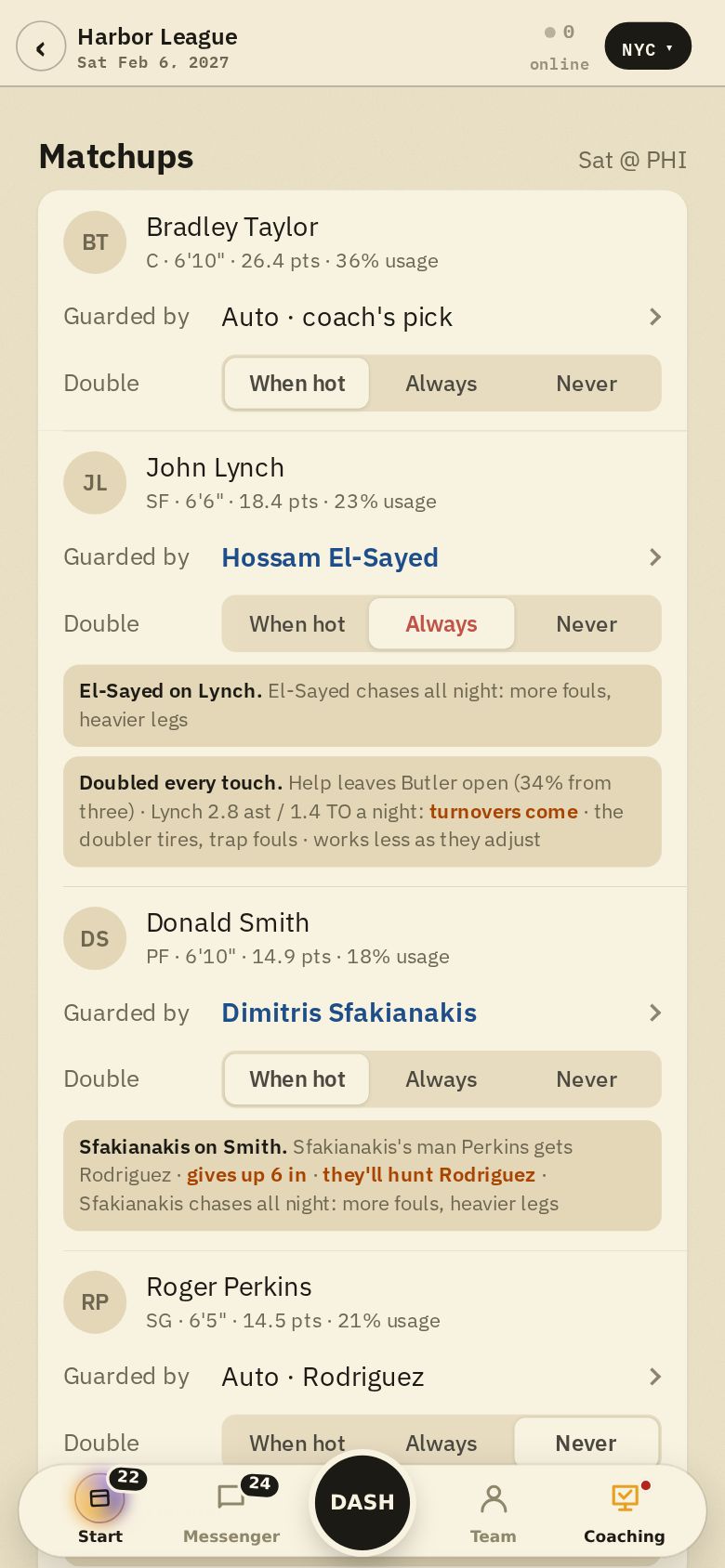
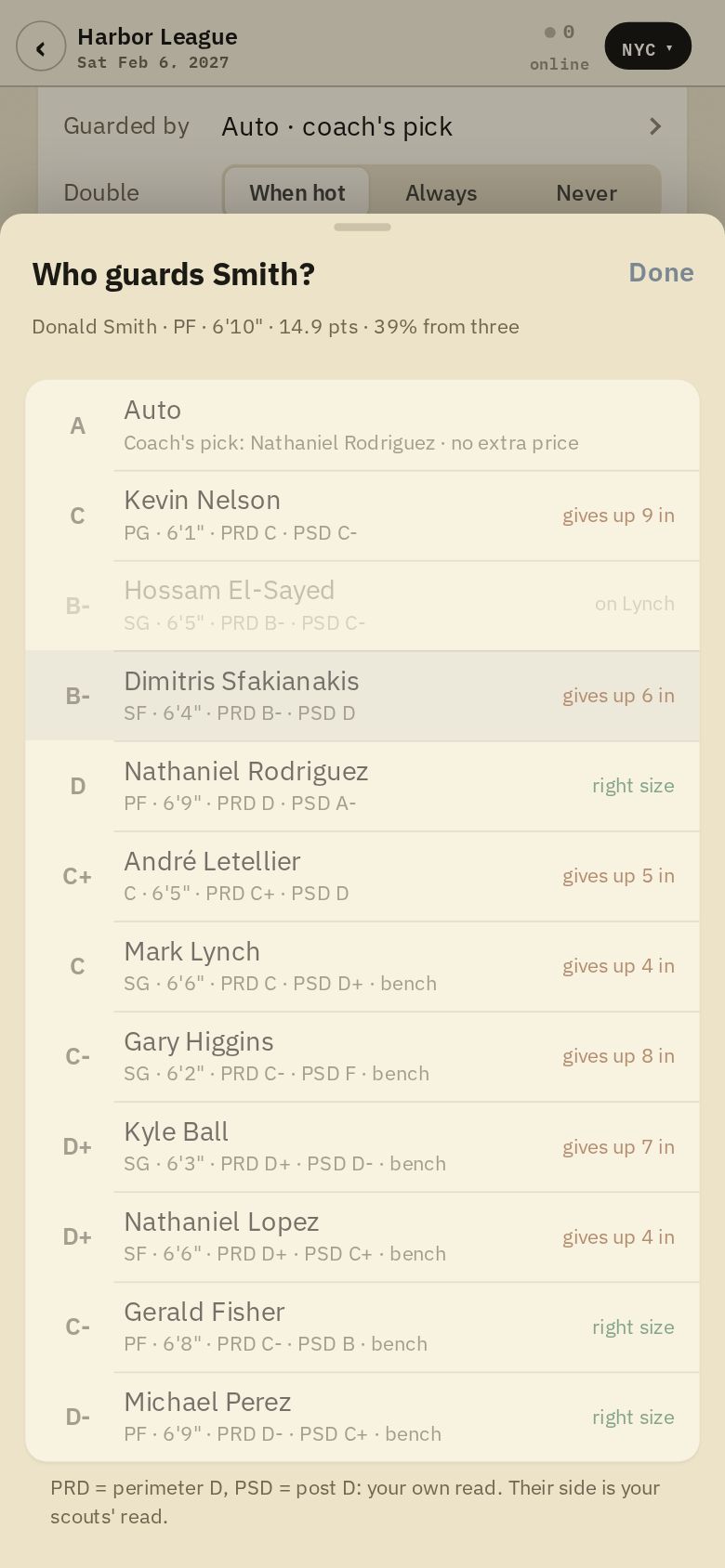
Guarded by picks who takes him. It starts on Auto, which is the engine's own matchup table: the same one it uses in every game, run on both starting fives, with their side read through your scouts. Auto names the defender it would use, and it updates as you go. If you put your shooting guard on their small forward, the man he leaves gets picked up by somebody else, and every Auto line below shows who that is now. You can set up to two matchups.
Double has three settings. When hot is the default and is exactly how the engine has always played: help comes when he gets going. Always sends a second defender on every touch. Never leaves his man alone with him all night.
- 1Guarded by · AutoThe engine's own matchup table on both starting fives. It renames the defender as you change other picks.
- 2Guarded by · your pickUp to two per game. The man he leaves goes to whoever is left, and Auto says who.
- 3Double · When hotThe default and how the engine already played: help comes when he heats up.
- 4Double · AlwaysA second defender on every touch, with the full price.
- 5Double · NeverHis man is alone with him all night. More isolations come his way.
The calls belong to that one game, saved with that game's plan. Next week's opponent starts fresh.
Double teams always have a price
That was the rule for this feature from day one. A double team in this engine is not a free stop. Each one takes a defender off somebody, and somebody else gets open. So before you save, every call writes a one-line price under the player: who the help leaves, what the star does against a trap, and what your doubler pays for it. Here is what the engine actually charges.
- 1The help leaves a real manThe kick-out goes to the player your doubler left. If he can shoot, he gets an open one.
- 2Passers beat itA star with Court Vision finds the open man. A weak ball handler coughs it up.
- 3The scrambleWhen your defense rotates, you give up more offensive rebounds and more closeout drives.
- 4The doubler paysTrapping wears him down and gets him into foul trouble.
- 5They adjustDouble every time and the offense learns where the help comes from. It works less as the game goes on.
- 6Never has a price tooNo help means more isolations for him. Your defender has to win them alone.
Matchups have a price too. When you move your best defender onto their star, his old man goes to whoever is left, and the offense notices. If that leaves a size gap, they post it up. If it leaves a weaker defender on a scorer, they go at him. The engine calls this a hunt, and it counts every one. Your stopper also chases all night, so he tires sooner and picks up more fouls. And a cross-match, like a guard on a forward, costs you on the break and on the defensive glass.
What the lab says
I wanted to know what a double really buys, so I ran it. I took 200 seeded games and played each one twice: once on the default, and once with one team doubling the other side's best scorer on every touch. Same seed, same rosters, same everything else.
It works on the star. He scores about two and a half fewer points, takes one and a half fewer shots, his usage drops almost two points, and he turns it over more.
Now the price. His teammates take almost one more three a game, they get half an offensive rebound more, and their offensive rating comes down about two points, not the five you might hope for. That's because the ball goes somewhere when he gives it up.
Doubling every touch meant about 11.6 doubles a game. Two of them became turnovers. Nine became kick-outs to the open man. One and a half gave them a second chance off the scramble. Each doubled trip still scored 1.22 points. Add it all up and the net margin hardly moved. Always is a real choice, not a free win. It's the right call against a scorer whose teammates can't punish it, and the wrong one against a passer surrounded by shooters.
Never is a choice too. With no help coming, he went one-on-one more often, and his true shooting slipped from .675 to .664. That's a small drop. If your man can hold him alone, you keep your other four at home.
Reading the results
After the game, the box score has a Matchups strip with your calls and their price: how many times you doubled him, the turnovers, kick-outs and second chances that followed, points per doubled trip against the league, and the shooting each guarded player managed against your pick.
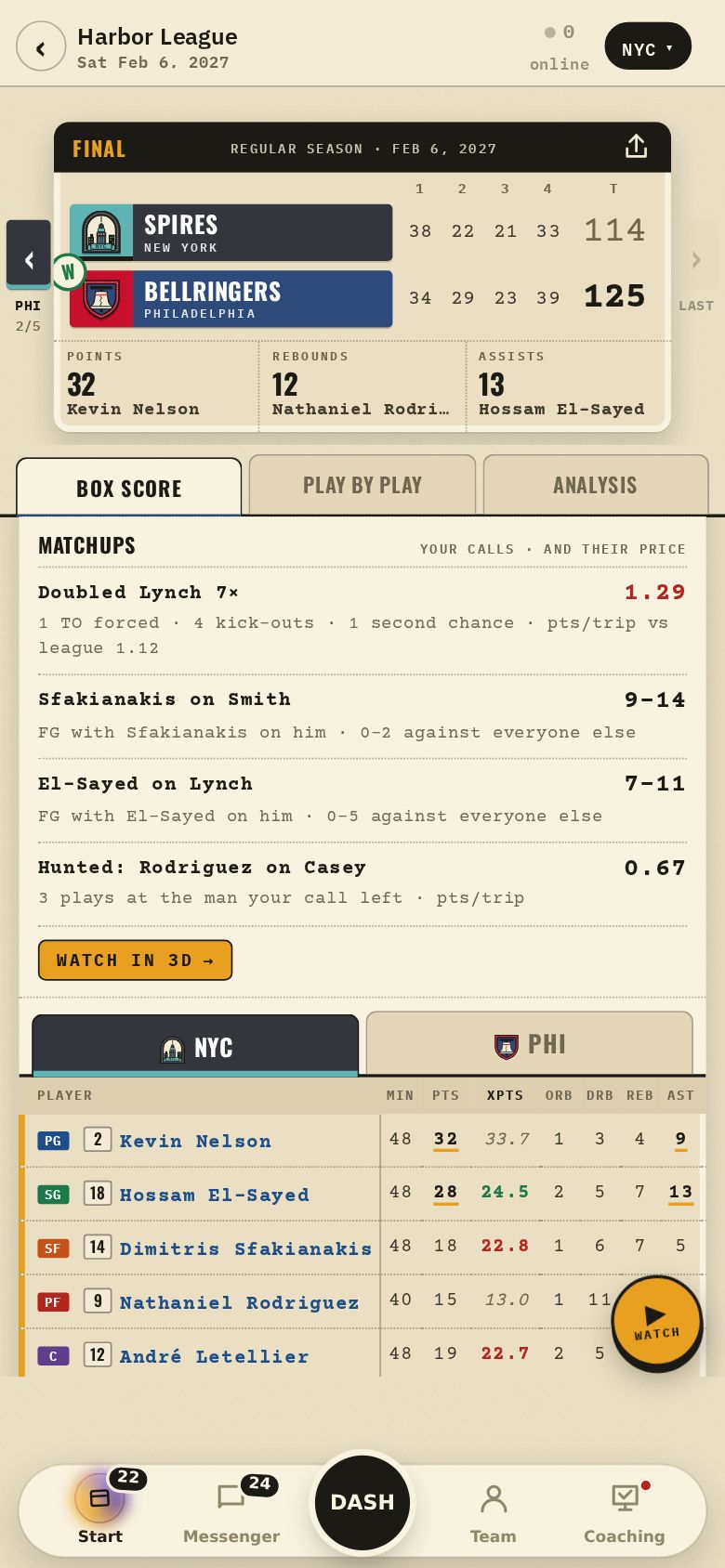
That's an honest example from a test game. Seven doubles on the star forced one turnover, but four kick-outs found the open man, and each doubled trip scored 1.29 points against a league average of 1.12. The strip doesn't flatter the call. It tells you what it cost.
Watch in 3D opens the Your calls card in Game Intelligence. Tap the court and it turns 3D, on the same court as the Style tab. Each double is a lit path: the doubler leaving his man, the trap, and the kick-out to the man who was left open. Below the court is every doubled trip and how it ended.
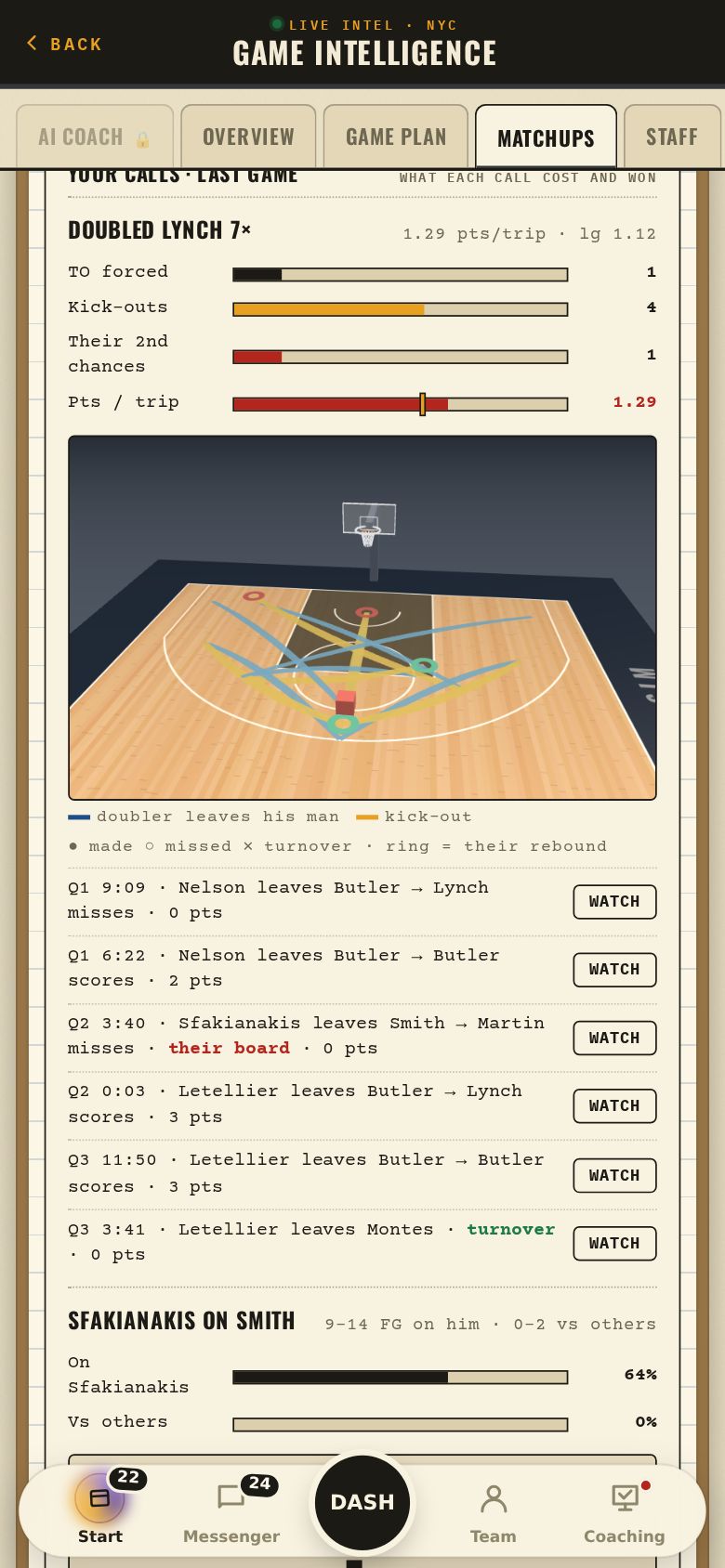
Every one of those trips has a Watch button. It replays that possession in the Sim Trace, so you see the trap and where the ball went next.
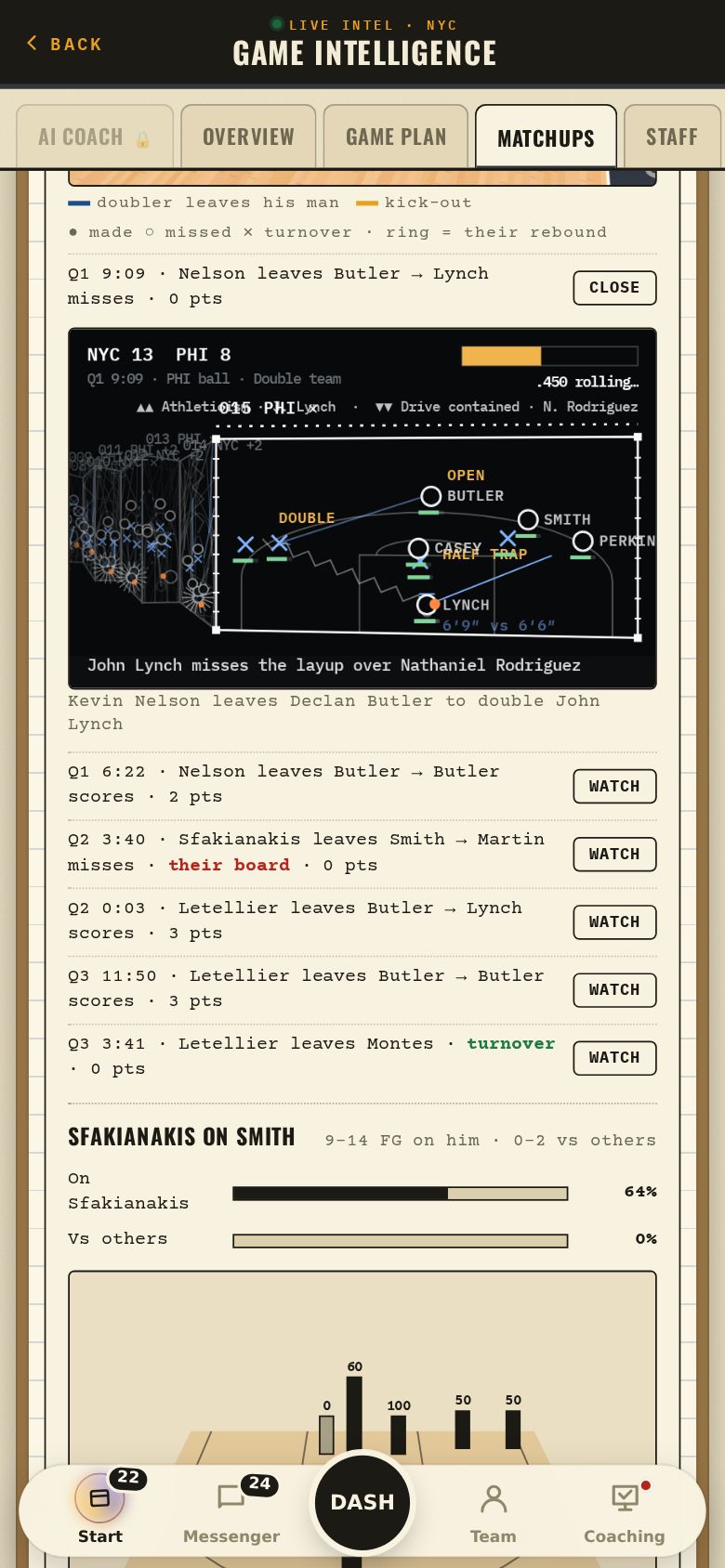
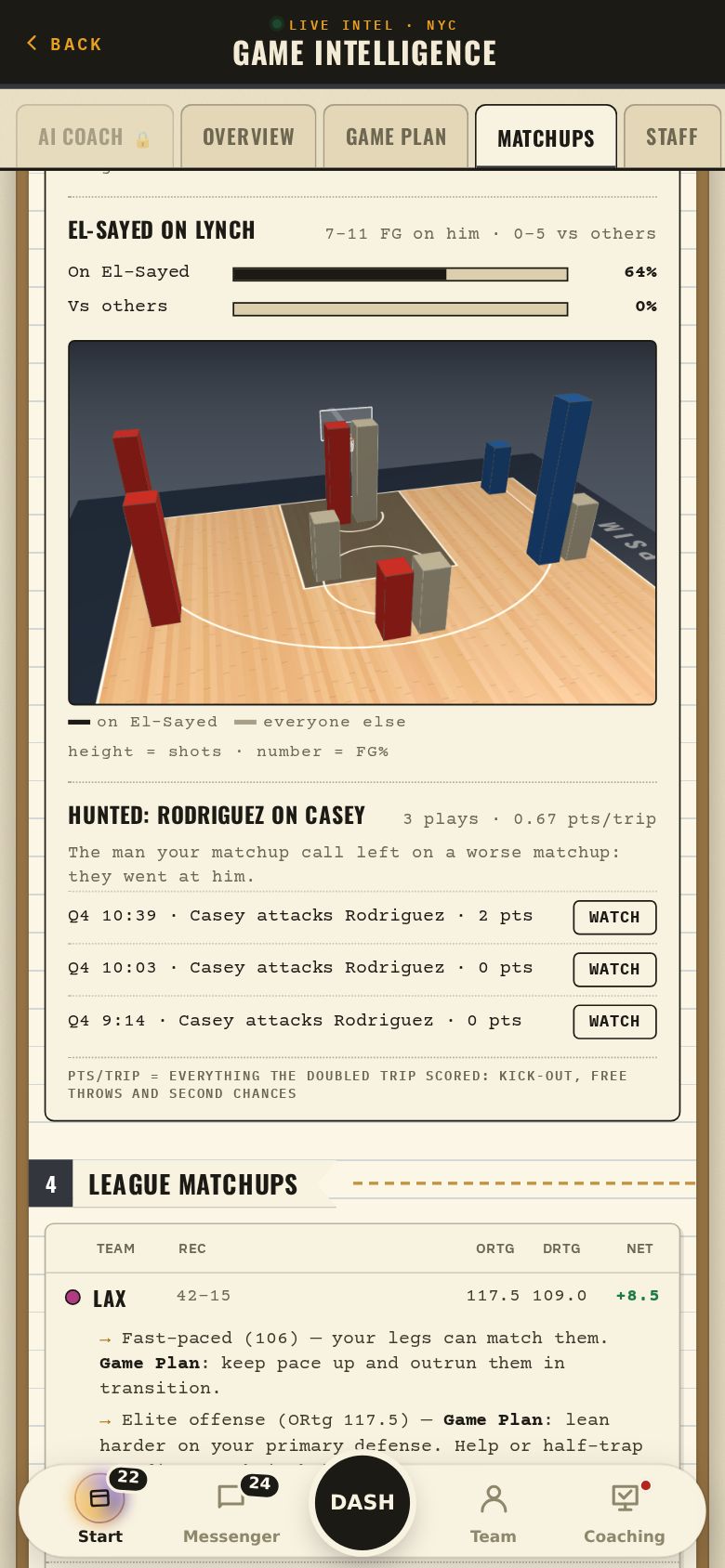
For a matchup, the card splits his shots by defender: his shots against your pick, and his shots against everyone else, as 3D towers where height is volume and the number is FG%. If your call left somebody on a bad matchup and the offense went at him, it shows up as Hunted, and each of those plays has a replay too.
Built ahead
Nothing 3D loads when you open a page. The court, the towers and the replays only load the first time you tap. The night's summary is computed once, after the sim, in the same background pass that builds the Style tab. So the box score and the Intel card only read one stored result.
“A double team is a loan. Somebody on the floor always pays it back.”